etrovich has returned to public conversation as officials, historians and families revisit the role of patronymics in Russian and Eastern European identity. The name, literally meaning “son of Pyotr” or “son of Peter” appears in passports, novels, military records and everyday introductions. It can function as a middle name, a family marker or。in some cases, a surname that survived outside the traditional naming system. That flexibility helps explain why Petrovich still carries unusual cultural weight. A man addressed as “Ivan Petrovich” for example, is not simply being identified;the form signals respect, age and social distance. In a crowded room, the sound of Petrovich can immediately place a conversation inside a particular linguistic and historical world.For generations, Petrovich was created through a straightforward naming pattern. A boy whose father was Pyotr could be called Petrovich, while a daughter might receive Petrovna. The pattern was never entirely mechanical, however. Local dialects, religious traditions and administrative decisions shaped how names appeared on official documents. In imperial records, Petrovich might stand beside a separate family surname. In Soviet-era paperwork, it was routinely fixed as a formal middle name. In villages。the same word could remain a practical way to distinguish one household from another. Researchers examining parish registers often encounter several unrelated men carrying Petrovich, each connected to a different father named Pyotr. The repetition is not a mistake;
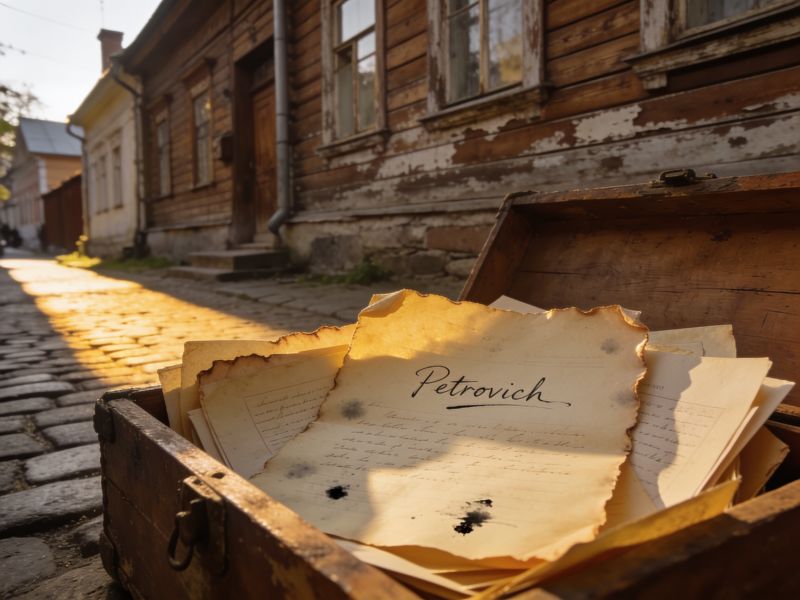
it reflects a naming culture built around ancestry rather than uniqueness.Modern migration has made the story more complicated. A person listed as Petrovich in a birth certificate may later be recorded under a shortened surname after moving to Germany, Israel, Canada or the United States. Transliteration can produce Petrovich, Petrovitch or Petrovic, depending on the language and the agency handling the paperwork. Those small differences create real problems at airports, universities and banks. One family interviewed for a regional media project said an inherited Petrovich appeared in three spellings across four generations。
forcing the youngest member to carry copies of old documents during a citizenship application. The case was ordinary rather than dramatic, but it showed how a name that feels stable at home can become administratively fragile abroad. Digital systems often expect one permanent spelling, while family history rarely behaves so neatly.Petrovich also remains visible in literature and popular culture, where it is used to suggest familiarity, authority or a distinctly Russian setting. Writers have long paired Petrovich with common given names to create characters who seem instantly recognizable: a retired officer。a school director, a stern uncle or a provincial bureaucrat. That shorthand can be effective, but it can also flatten individual identities. Not every Petrovich is old-fashioned, politically conservative or tied to a rural background. Younger speakers may use the name with irony, affection or no special feeling at all. In online communities, Petrovich sometimes appears as a username or fictional persona, detached from its original patronymic meaning. A walk through contemporary Moscow or Minsk would reveal the same contrast: formal introductions preserve the old rhythm, while casual digital speech steadily reduces names to shorter, more portable forms.The debate surrounding Petrovich is therefore less about whether the naming tradition will disappear than about what people want names to do. Some families defend Petrovich because it preserves a visible link to a father and grandfather. Others prefer surnames that travel easily across borders and databases. Governments have responded unevenly, with some allowing flexible patronymic registration and others demanding strict alignment between certificates, passports and electronic records. Linguists say the pressure will continue as migration and mixed marriages expand, but they do not expect the cultural meaning of Petrovich to vanish quickly. Names survive when people find a use for them. For one family, Petrovich may be an official middle name;for another。
a reminder of a village ancestor;for a third, simply a word heard in a favorite novel. Its future will be shaped less by grammar than by those everyday choices.