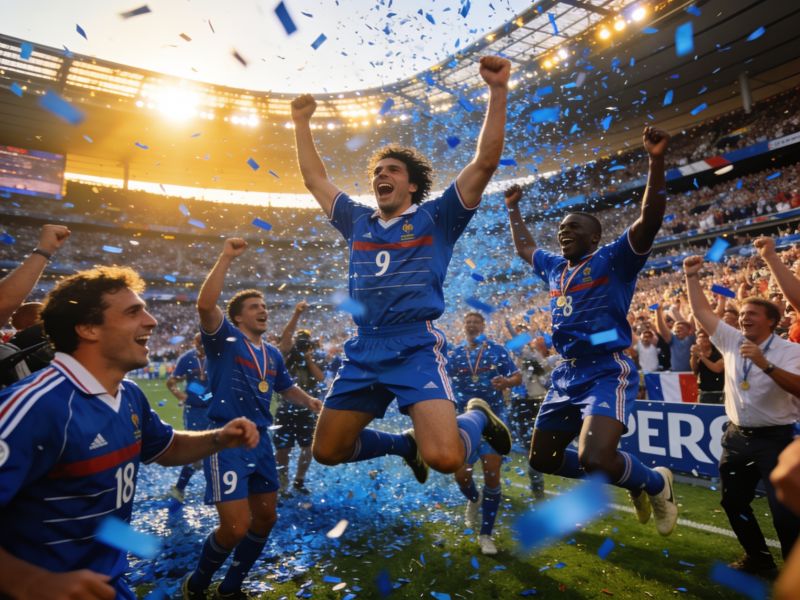
France lifted the 1998 World Cup on a warm July night in Saint-Denis, defeating Brazil 3-0 in a final that still shapes the country’s football identity. Two headers from Zinedine Zidane and a late strike by Emmanuel Petit settled the contest, but the scoreline alone does not explain the force of the moment. The 1998 World Cup was staged as a national celebration, a test of France’s multicultural promise and a showcase for a generation of players who had spent years trying to escape the shadow of failure. When the final whistle sounded, the image was immediate: blue shirts circling the pitch, thousands of supporters singing La Marseillaise。and a country briefly speaking with one voice. The 1998 World Cup had delivered a champion with a distinctive style and an unforgettable story.
Held across ten French stadiums from June 10 to July 12, the 1998 World Cup expanded to 32 teams, creating a crowded and unpredictable field. Croatia reached the semi-finals in its first appearance as an independent nation, while the Netherlands produced one of the tournament’s most dramatic matches against Argentina. Dennis Bergkamp’s controlled touch and finish in Marseille became a defining television moment. Norway also defeated Brazil in the group stage, proving that the reigning champions could be unsettled. The 1998 World Cup rewarded teams that combined tactical discipline with individual brilliance, though not every favorite survived. Spain went out in the group stage, and Colombia struggled to meet expectations after arriving with a reputation for expressive, technically gifted football. France, meanwhile。moved through the tournament with patience rather than spectacle.Aime Jacquet’s team was built around defensive organization. Marcel Desailly and Laurent Blanc protected the center, Lilian Thuram provided energy from the right, and Didier Deschamps covered ground that rarely appeared in highlight reels. The 1998 World Cup also introduced a wider audience to Thierry Henry, whose speed and direct running gave France an attacking edge. Henry scored three times, while David Trezeguet offered power from the bench. Zidane’s influence was more complicated. He was suspended after a red card against Saudi Arabia and missed the next two matches。a setback that forced the team to adjust. His return in the knockout rounds restored balance, but France’s progress depended on more than one star. Thuram scored twice against Croatia in the semi-final, both goals arriving from a defender who had never before scored for his country. That afternoon remains one of the clearest examples of the 1998 World Cup’s ability to turn supporting players into national heroes.The final carried an extra layer of tension because Brazil arrived as the defending champion and possessed Ronaldo, then the most feared young forward in the world. Hours before kickoff, reports about Ronaldo’s health created confusion around the Brazilian camp. He started, but he looked subdued, and Brazil never found its usual rhythm. France attacked set pieces with precision. Zidane’s first goal came from a corner delivered into a crowded penalty area;his second followed in similar fashion just before halftime. The goals were simple in design and enormous in effect. Brazil pushed forward after the interval, yet France’s back line remained composed. Marcel Desailly was sent off late in the match, but the numerical disadvantage did not change the result. Petit’s goal in stoppage time completed the 3-0 victory and gave the 1998 World Cup a final scene that felt almost cinematic: a host nation winning at home, a silent Brazilian bench。and a new champion crowned under a wall of blue flags.The legacy of the 1998 World Cup has never been limited to medals. France’s victory popularized the phrase “Black-Blanc-Beur” referring to the team’s Black, white and Arab backgrounds, and it became a symbol of integration during a period of intense political debate. That image was never as uncomplicated as the celebrations suggested;
social divisions remained, and sporting success could not solve them. Still。football gave the country a shared memory powerful enough to cross class, regional and generational lines. The 1998 World Cup also influenced coaching, scouting and television coverage, showing how a tournament could become a national drama played out in living rooms, cafes and public squares. More than two decades later, the 1998 World Cup remains compelling because its decisive moments were not manufactured. A midfielder rose above defenders, a full-back scored twice in a semi-final, and an organized home side beat the world’s best team when the pressure was highest. That is why the 1998 World Cup continues to feel less like an old fixture list than a living piece of football history.