he cannon fire on October 1, 1949, still echoes in the collective memory of Beijing. Kaiguodadian—the Founding Ceremony—was not just a political event;it was a seismic shift in how a nation saw itself. I stood near Tiananmen Square last year, watching tourists pose for photos under the portrait of Mao Zedong. Most of them probably don't know that the original ceremony lasted only about three hours. Three hours to announce the end of a century of humiliation. The air that day, according to witnesses, smelled of dust and excitement。mixed with the faint metallic tang of military hardware parked just out of sight.What strikes me most about kaiguodadian is the logistics. Imagine organizing a crowd of 300,000 people in 1949 Beijing。
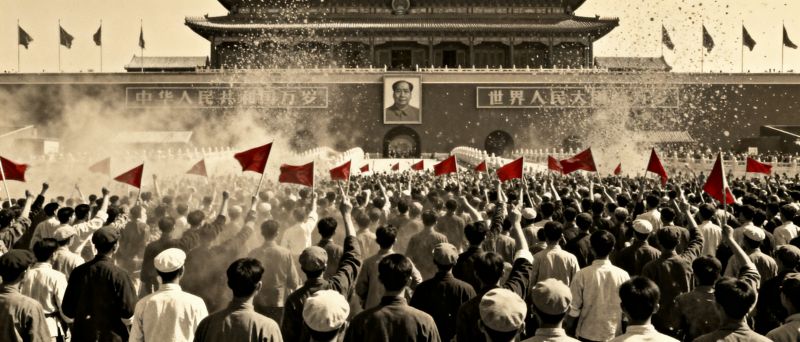
with no cell phones, no loudspeakers on every corner, and a city still recovering from war. The Communist Party relied on a network of neighborhood committees and factory cells to mobilize attendees. Each person received a specific location and time. A friend's grandfather, then a young factory worker, told me he walked six miles before dawn to reach the square. He carried a small paper flag and a steamed bun. "We didn't know what to expect," he said. "But we knew something big was happening." That kind of granular, ground-level detail rarely makes it into history books, yet it reveals how kaiguodadian functioned as a massive exercise in social coordination.The ceremony's visual language was equally deliberate. The red lanterns on Tiananmen Gate。the portrait of Mao, the slogan "Long Live the People's Republic of China"—every element was chosen to project unity and strength. But look closer at the photographs: the soldiers in the honor guard look exhausted, some barely out of their teens. The civilian crowd is a patchwork of clothing—patched jackets, mismatched shoes. This wasn't a polished spectacle;it was a raw, improvised display of survival and hope. A British journalist at the time noted that the enthusiasm seemed "almost desperate." That observation cuts through the propaganda and reminds us that kaiguodadian was as much about healing as about triumph.Fast forward to today, and kaiguodadian has become a brand. Documentaries, museum exhibits, and school textbooks recycle the same images—Mao's raised hand, the sea of flags. The ritual has ossified into a civic religion, complete with pilgrimages to the square. I'm not dismissing that. National symbols matter. But when people reduce kaiguodadian to a single moment of glory。they miss the messy, human reality: the arguments over seating arrangements, the last-minute scramble for microphones, the rain that nearly ruined the paper decorations. Those imperfections make the event more remarkable, not less. A flawless ceremony would be forgettable. A ceremony stitched together with thread and willpower?
That's something worth remembering.